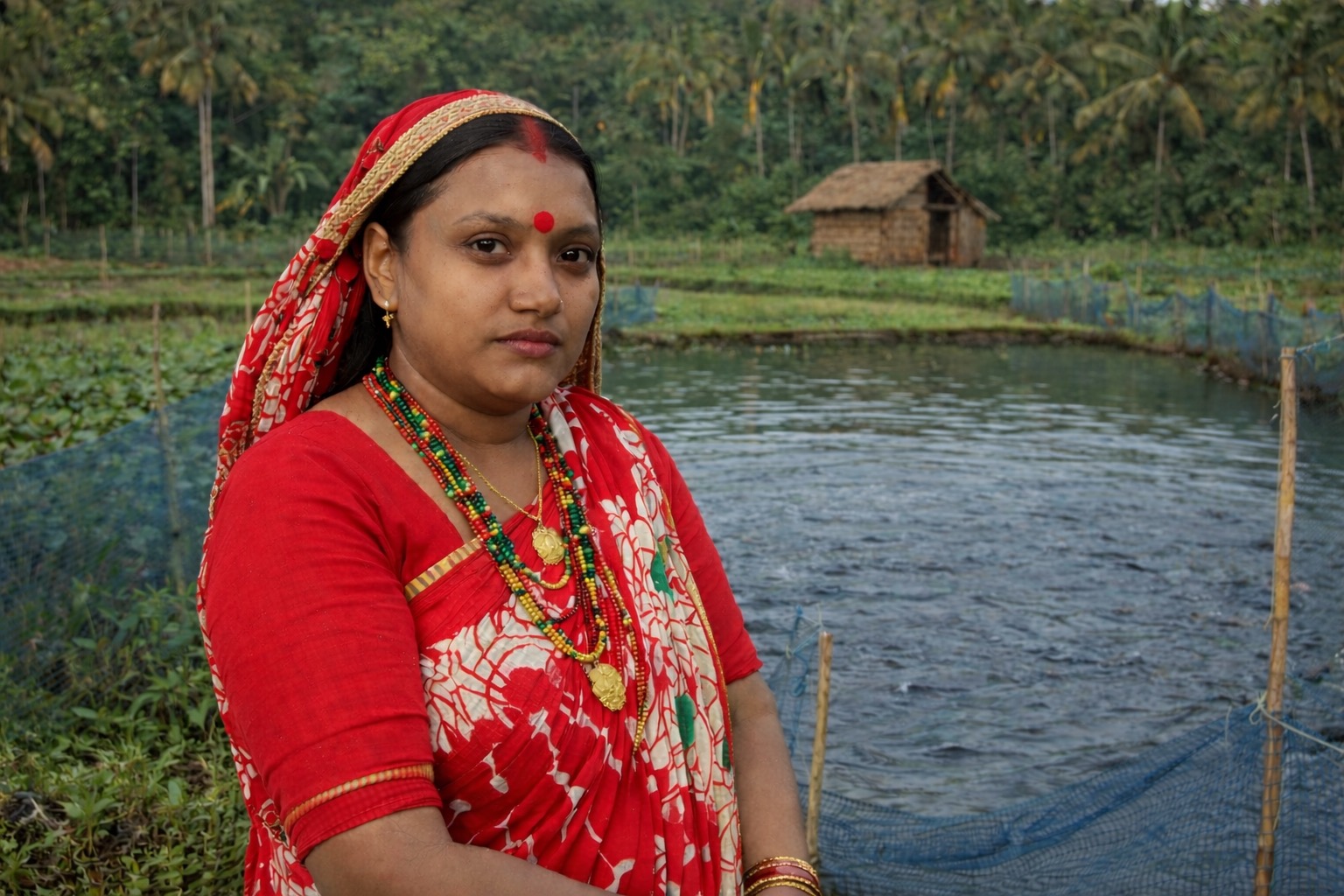
“Before this, I was always worried about how I would provide for my children. Starting my own fish farm has changed that. My income has increased, I can care for my family with more confidence, and I feel proud that I am building a better future for my children with my own hands.”
— Mandira, Baseri Village, Dhading
In Baseri Village, Dhading, many families live with a narrow margin for error. A poor harvest, rising food prices, illness, or the loss of income can quickly place a household under strain. In this context, food insecurity is not only about what is missing today. It is about how fragile tomorrow can feel.
That is the reality Sustainable Fish Farming Initiative is working to change.
Through a focused field project in Baseri Village, SFFI delivered 20 technical training sessions reaching 500 farmers, helping rural households strengthen fish farming as a practical pathway to improved nutrition, more stable income, and greater resilience over time.
The project was designed around a simple but important principle: when farmers have access to practical knowledge, locally relevant support, and skills they can use immediately, they are better equipped to build livelihoods that hold.
A practical approach to rural resilience
Fish farming can play a meaningful role in rural livelihoods when it is supported well. For households in Dhading, it offers more than one benefit. It can improve access to nutrient-rich food, create additional income opportunities, and provide a productive asset that grows over time.
But success in fish farming does not happen automatically. It depends on technical knowledge, sound management, and the confidence to apply that knowledge under real conditions.
That is why SFFI’s field trainings focused on the practical foundations of smallholder aquaculture, including:
- pond preparation and embankment maintenance
- pond conditioning and liming
- healthy stocking practices
- feed timing and ration management
- water quality awareness
- routine pond monitoring and fish health observation
- harvest planning for both home consumption and local sale
These were not abstract sessions. They were designed for the conditions farmers in Baseri Village actually face: limited capital, time pressure, variable water conditions, and the need to make each livelihood decision count.
With 500 farmers reached across 20 trainings, the project combined scale with practical learning, creating space for direct participation while ensuring that technical knowledge remained usable and rooted in local realities.
When knowledge becomes opportunity
At the heart of this work is a simple belief: rural families do not lack determination. Too often, they lack access to the right tools, information, and support systems. When that gap begins to close, the results can be transformative.
For Mandira, 35, a single mother of five children, the training became more than a learning opportunity. It became the beginning of a new livelihood.
Before joining the project, Mandira was supporting her family under difficult conditions, carrying the daily pressure of providing food, care, and financial stability for her children. Through the training, she gained practical knowledge in pond preparation, stocking, feeding, and day-to-day fish farm management. With that knowledge, she took a significant step forward: she started her own fish farming enterprise.
Since then, Mandira’s household has seen a 90% increase in income.
Her story reflects what this project is ultimately about. Not only better production. Not only improved technical practice. But the possibility of turning knowledge into agency, and agency into lasting change.
Building stronger livelihoods from the ground up
The significance of this project lies not only in the number of farmers reached, but in where the knowledge was placed: directly in the hands of rural producers.
When farmers understand how to prepare ponds properly, manage inputs more carefully, monitor fish health, and reduce avoidable losses, they are better able to turn effort into stronger results. When women gain access to those same skills and opportunities, the effects often extend beyond income to food security, household confidence, and long-term stability.
That is especially important in communities where livelihoods are fragile and opportunity is unevenly distributed. In these settings, diversification is not a luxury. It is a form of protection. A stronger pond can mean a stronger household. A stronger household can mean children with better nutrition, more stability, and more room to hope.
What this update shows
This field project in Baseri Village points to something important: practical, community-rooted training can help families build more resilient futures.
Through 20 technical trainings reaching 500 farmers, SFFI is helping strengthen fish farming as a viable livelihood strategy in Dhading. And for women like Mandira, that support is already translating into measurable change.
There is still much work ahead. But in Baseri Village, the foundation is being laid carefully and locally — farmer by farmer, household by household, season by season.
That is what progress looks like in practice.