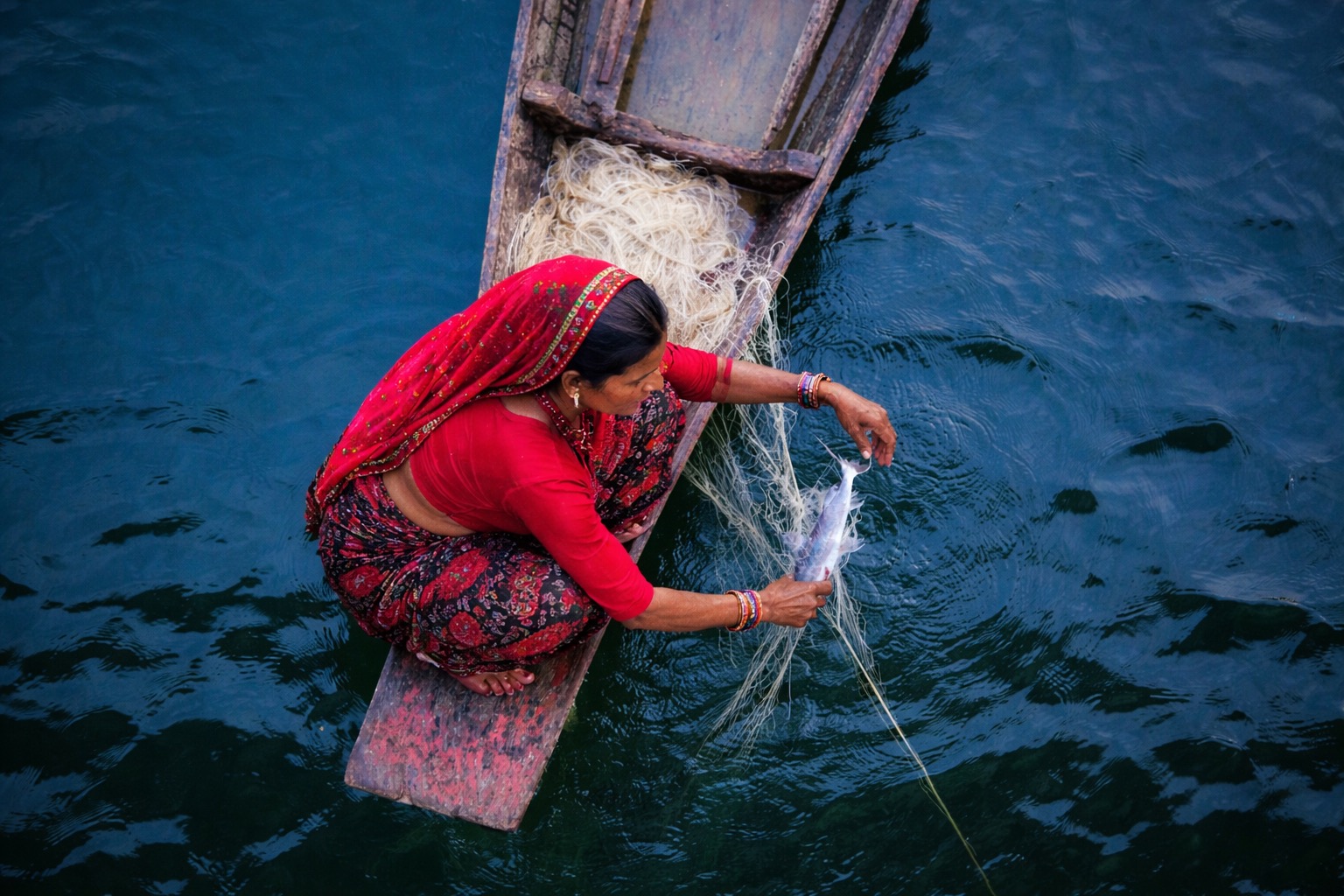
When gender gaps were better understood, support became more targeted, more practical, and more effective.
Closing gender gaps started with understanding where they persisted, how they shaped livelihoods, and what kinds of interventions shifted outcomes.
In Nepal, women made up more than half of the country’s farmers, yet only around one-third owned farmland. At the same time, high levels of child stunting continued to underline the need for livelihood models that strengthened both incomes and diets. Against that backdrop, aquaculture became increasingly relevant—not only as a source of income, but as part of a broader pathway toward food security, resilience, and women’s economic empowerment.
For Sustainable Fish Farming Initiative, that reality shaped both the design of its work and the way it measured progress. In Baseri Village, Dhading, the initiative delivered 20 technical training sessions reaching 300 farmers. In Chitwan, it trained 250 farmers and provided microfinance grants to women farmers. These experiences showed that when technical support was paired with women-centered financing and locally rooted delivery, fish farming could contribute to stronger livelihoods and improved household wellbeing.
How we collected gender data
Gender-responsive monitoring, evaluation, and learning served as more than a reporting function. It helped reveal whether women were not only participating, but also benefiting in meaningful ways.
That distinction mattered in rural Nepal, where women’s labor remained central to agriculture while access to productive assets, finance, and decision-making power often remained unequal. Measuring attendance alone could not capture that reality. What mattered was whether women were able to translate participation into productivity, income, agency, and improved wellbeing at household level.
The initiative’s learning approach therefore focused on two connected questions: whether women and men experienced different outcomes in fish farming, and whether women’s agency strengthened through participation in the program.
Track 1: Gender-disaggregated productivity & income
The first track focused on productivity and income.
In aquaculture, as in much of agriculture, productive activity often took place at household level. That meant it was not enough to record who attended training sessions or who was listed as a participant. It was also necessary to understand who made decisions about pond preparation, stocking, feeding, harvesting, marketing, and the use of income from fish sales.
Tracking these dynamics helped bring hidden inequalities into view. It showed where women faced constraints in entering fish farming, adopting improved practices, or benefiting equitably from the returns generated. It also helped identify which forms of support were most effective in moving women from participation to measurable livelihood gains.
This mattered because women’s involvement in agriculture did not automatically translate into control over productive outcomes. When women had access to training but lacked access to land, ponds, capital, or authority over enterprise decisions, the impact of programming remained limited. Gender-disaggregated learning helped make those constraints visible and actionable.
Track 2: Women’s empowerment & agency
The second track focused on women’s empowerment and agency.
Productivity mattered, but development outcomes became stronger and more durable when women were able to make and act on decisions that affected their livelihoods and their households. This meant paying attention not only to income gains, but also to questions of influence and control: whether women had a say in production decisions, whether they participated in decisions about sales and household spending, whether they had sole or joint control over productive assets, and whether enterprise activity strengthened their confidence and economic standing.
The importance of this was already visible in field experience. In Baseri, Mandira, a 35-year-old single mother of five, used training to start her own fish farm and reportedly increased household income by 90 percent. In Chitwan, Sumnima, age 28, helped support her family through income earned from the program. These were individual cases rather than portfolio-wide claims, but they pointed to a broader lesson: women’s agency was visible not only in participation, but in enterprise decisions, income use, and household wellbeing.
Women’s empowerment was not treated as a secondary outcome. It was central to how impact was understood.
Using insights to drive change
The purpose of collecting gender data was not to produce better dashboards. It was to improve decisions.
When data showed that women attended fewer trainings because schedules conflicted with care responsibilities, outreach methods and delivery times were adjusted. When women completed training but could not establish ponds because of capital constraints, women-centered finance mechanisms were strengthened. When women contributed substantially to pond management but had limited influence over sales and income use, the program incorporated stronger support for household dialogue and shared decision-making.
This was where gender-responsive learning moved from observation to action. By linking participation data with evidence on productivity, income, and agency, the initiative identified which combinations of training, finance, and community engagement produced stronger outcomes for women farmers.
That shift mattered in a country where aquaculture continued to grow, fish became an increasingly important source of animal protein, and women already formed a large share of the agricultural workforce. Better data helped bridge the gap between participation and equitable benefit by showing where inequalities persisted and what kinds of program responses were most likely to reduce them.
Looking ahead
The experience in Nepal showed that sustainable fish farming could do more than generate income. It could help strengthen diets, diversify livelihoods, expand women’s economic participation, and build resilience at household level.
The opportunity, therefore, was not simply to scale activity, but to strengthen the evidence behind it. That meant treating gender data as core program infrastructure: essential to design, implementation, learning, and accountability. It meant measuring not only how many women were reached, but whether productivity improved, incomes grew, agency expanded, and households became more secure as a result.
When that happened, gender-responsive aquaculture was no longer a niche intervention. It became part of a broader rural transformation agenda.
Because when women farmers prospered, households became more secure, communities became more resilient, and development impact became more durable.