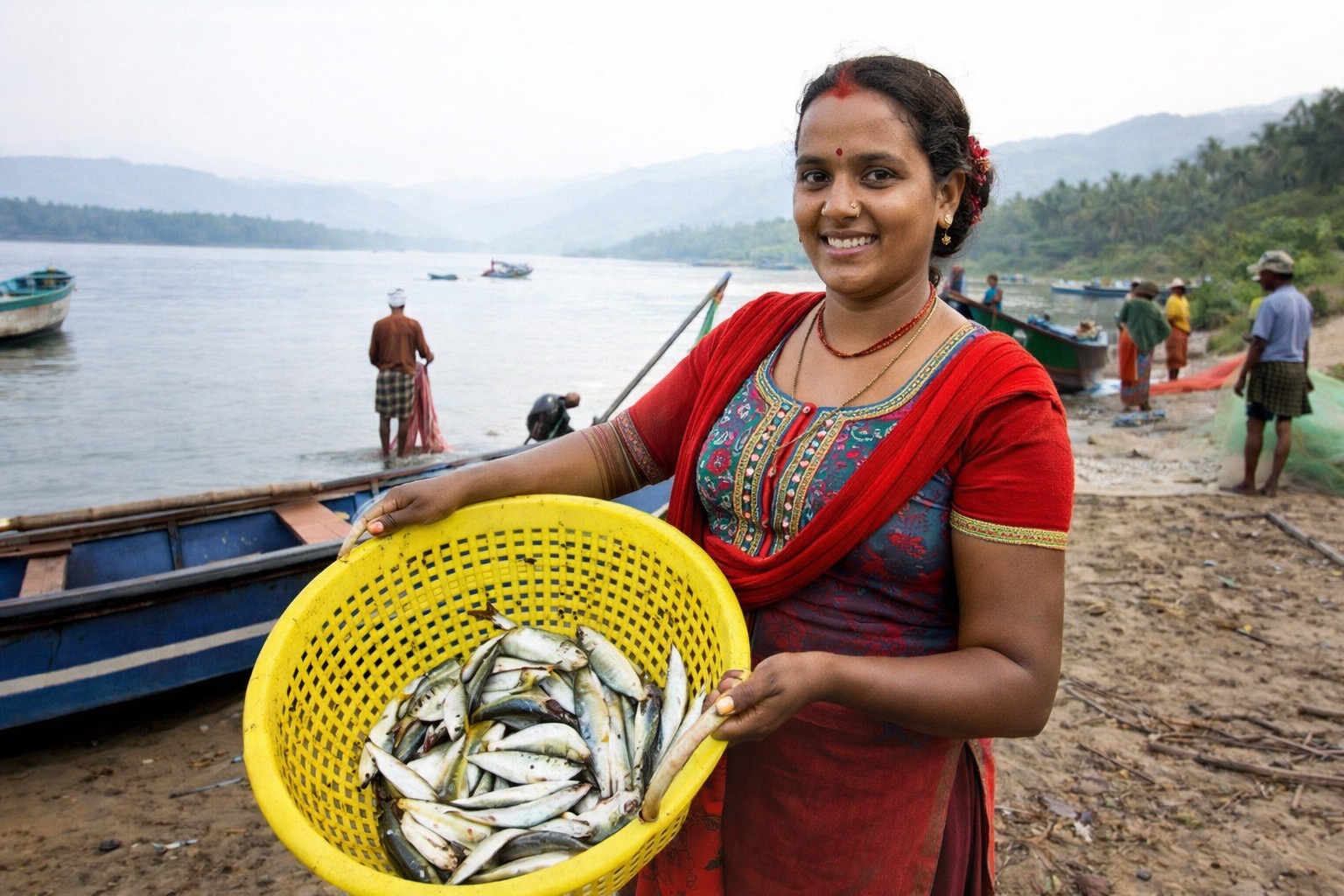
“This program gave me more than training. It gave me a way to earn, support my family, and believe that I could build something of my own.”
— Sumnima, Chitwan
It is early morning in a village in Chitwan, Nepal, and the first light has just spread across 28-year-old Sumnima’s home. The day has only begun, but Sumnima is already at work, moving steadily through the pond and surrounding area that now help sustain her family. Her mornings, like so much of her life, are shaped by care, labor, and responsibility. There is little room for delay when a family depends on what a day’s work can provide.
As she tends to the fish farming work that has become central to her livelihood, she also sees something that has become deeply important to her: a source of income she can rely on. It is not only the fish pond itself, or the labor it requires, that matters. It is what the work now makes possible. The income she earns is helping her provide for her family, meet household needs with greater confidence, and build a more stable path forward.
For Sumnima, fish farming is more than a livelihood. It is a way of carrying her family forward.
That shift did not happen on its own. It grew out of support designed to meet rural women where they are: hardworking, capable, and full of potential, but too often under-supported when it comes to the tools, knowledge, and capital needed to build a stronger economic future.
Through a project in Chitwan, the Sustainable Fish Farming Initiative (SFFI) trained 250 farmers and provided microfinance grants to women farmers, helping expand both the technical knowledge and financial support needed to make fish farming a more viable livelihood. For women like Sumnima, that combination mattered. Training provided the practical skills. Microfinance made it possible to act on them.
A livelihood built on more than effort
For many women in rural communities, the barrier is not determination. It is access.
A woman may have the discipline to build a livelihood, the willingness to work, and the daily responsibility of caring for a family, yet still be held back by limited capital, too few opportunities, and a lack of support at the exact moment it is needed most. She may know how important income is. She may understand what her family needs. But without technical guidance, financial support, or a pathway to begin, that knowledge alone does not always become opportunity.
That is why SFFI’s work in Chitwan was designed to support women farmers more fully.
The project combined practical fish farming training with microfinance grants, helping women gain both the skills and the financial foundation needed to begin, strengthen, or expand their work. Farmers were trained in key areas of aquaculture, including pond preparation, stocking, feeding, routine maintenance, and the day-to-day management needed to improve productivity and reduce avoidable losses. This was not training built around theory alone. It was built around the realities of smallholder life — the realities of limited resources, careful decisions, and the need to make each effort count.
For Sumnima, this support became a turning point.
The revenue she now earns through the program is helping her care for her family and meet household needs with greater confidence. In practical terms, that means more stability around essentials: food at home, day-to-day expenses, and the ongoing pressures that shape family life. What once may have felt uncertain now carries more structure, more predictability, and more possibility.
That kind of change matters deeply. In rural households, even modest increases in stability can transform how a family experiences the future. Daily life becomes a little less fragile. Financial decisions feel a little less impossible. And the work a woman does begins to return not only income, but confidence.
When women earn, the impact extends beyond income
A stronger livelihood for a woman rarely affects only one person.
It moves through the household. It shapes whether there is food at home, whether daily needs can be met more reliably, and whether life feels a little less exposed to disruption. It can ease the pressure that families carry from one week to the next. It can create more room to plan, more space to breathe, and more reason to believe that hard work can lead to something steadier.
That is part of what makes Sumnima’s story so important.
Her progress reflects a larger truth that development work too often understates: when women are trusted with both knowledge and investment, the benefits extend far beyond income alone. They strengthen households. They improve resilience. They build confidence. And they contribute to a more secure future for entire families.
For women in rural communities, livelihood is never only about earning. It is also about care. It is about whether children’s needs can be met, whether there is enough food in the home, whether emergencies feel survivable, and whether tomorrow seems a little less uncertain than today. When a woman’s economic footing becomes stronger, the emotional and material life of the household often shifts with it.
In that sense, Sumnima’s story is not just about a woman earning from fish farming. It is about a woman helping stabilize the world around her.
Why this model matters
The Chitwan project reached 250 farmers, but its significance is not only in the number.
What matters is that the project recognized something essential about rural livelihoods: training by itself is not always enough, and finance by itself is not always enough. Knowledge without capital can leave women prepared but unable to move. Capital without knowledge can create risk without stability. But when the two are combined, the path from learning to livelihood becomes far more real.
That is what SFFI helped create in Chitwan.
By pairing technical fish farming training with microfinance grants for women farmers, the program gave women a stronger chance to translate effort into income, and income into greater household security. It treated women not as passive recipients of support, but as economic actors capable of building, managing, and growing livelihoods of their own when given the right foundation.
That distinction matters. Too often, rural women are expected to carry enormous responsibility without receiving equal access to productive resources. They are central to family wellbeing, yet frequently peripheral in the design of livelihood systems. Programs like this matter because they begin to correct that imbalance. They create entry points for women to participate more fully, earn more directly, and shape the future of their households with greater agency.
For Sumnima, that support is no longer abstract. It is visible in the life she is building.
A future taking shape, one day at a time
Sumnima’s story is, at its heart, a story about agency.
It is about what becomes possible when a woman is not only willing to work, but is given the tools and support to build something that can last. It is about a livelihood becoming more than a source of income. It becomes a source of dignity. A source of stability. A source of hope.
At 28, Sumnima is helping shape that future for her family through the revenue she now earns from fish farming. The work is still demanding. The responsibility is still great. The days are still long. But the future she is building is no longer defined only by limitation.
It is being shaped by opportunity, persistence, and the strength of a woman building something of her own.
And that may be the most important part of this story.
Not only that Sumnima is earning.
Not only that she is working.
But that her work is creating something steadier beneath her family’s life — a stronger foundation, a more reliable livelihood, and a future shaped not only by hardship, but by possibility.
In Chitwan, that future is still taking shape. It is still being built through daily effort, careful choices, and the quiet determination that often goes unseen. But it is real. And in households like Sumnima’s, it is already making a difference.